
nikon d5200 instruction manual
Welcome! This comprehensive guide, mirroring the Nikon D5200 Manual, assists users in maximizing their camera’s potential. Explore features via online or downloadable PDF resources.
Overview of the Camera
The Nikon D5200 is a versatile DSLR, offering a 24.2-megapixel DX-format sensor and EXPEED 3 image processing. It’s designed for both beginners and enthusiasts, providing high-quality images and videos. Access detailed instructions through the official Nikon Manual Viewer 2 app, available on App Store and Google Play. The 432-page PDF manual offers comprehensive guidance, covering everything from basic operation to advanced features, ensuring users fully understand their D5200.
Key Features and Specifications
The D5200 boasts a 24.2MP DX-format CMOS sensor, 3.0-inch tilting LCD, and 5 frames per second continuous shooting. It supports Full HD 1080p video recording. Compatibility extends to wireless remote controllers like the WS-5 and WS-6. Detailed specifications, comparing it to models like the D3100, D7000, and D7100, are available in comprehensive documentation, including the downloadable PDF manual.

Getting Started with Your D5200
Begin your journey! Unbox, insert the battery and memory card, and access the detailed user manual – available online or as a PDF download.
Unboxing and Initial Setup
First steps are crucial! Carefully unpack your Nikon D5200, verifying all included components. Before powering on, familiarize yourself with the camera body and available ports. Download the comprehensive user manual – accessible as a PDF or online – for detailed guidance. This manual, mirroring the Nikon D5200 Manual, will prove invaluable as you navigate initial setup procedures and begin exploring your new DSLR’s capabilities. Ensure you have a compatible memory card ready for insertion.
Inserting the Battery and Memory Card
Powering up and storing images! Locate the battery compartment door on the camera’s base. Insert the supplied battery, ensuring correct polarity, until it clicks into place. Next, open the memory card slot cover and insert a compatible SD card, label-side up, until it locks. Refer to the Nikon D5200 Manual for detailed diagrams. Proper insertion is vital for reliable operation and image storage.
Understanding the Camera Controls
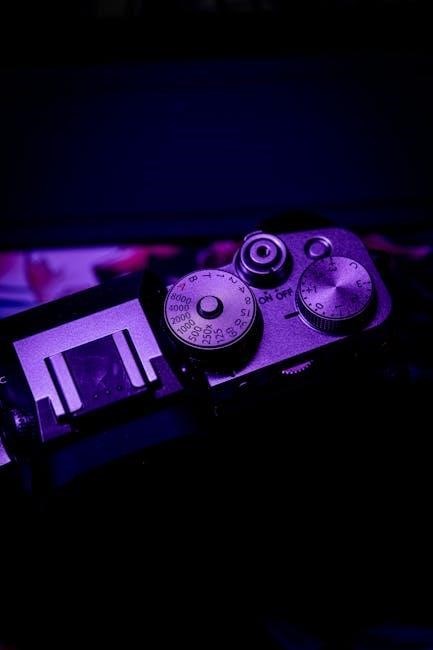
Mastering operation! Familiarize yourself with the mode dial and menu system for optimal control. The Nikon D5200 Manual provides detailed explanations of each function.
The Mode Dial Explained
Unlock creative control! The Nikon D5200’s mode dial offers diverse shooting options. Auto modes simplify operation, while Programmed Auto allows some adjustments. Aperture Priority (A) and Shutter Priority (S) grant manual control over specific settings. Manual (M) provides full creative freedom. Scene modes cater to specific situations, and the effects mode adds artistic flair. Refer to the D5200 manual for detailed explanations of each mode and its applications, ensuring you capture stunning images tailored to your vision.
Navigating the Menu System
Master the settings! The Nikon D5200’s menu system, accessible via the ‘MENU’ button, organizes settings into categories. Utilize the directional pad to navigate and the ‘OK’ button to select. Explore options for image quality, autofocus, ISO, and custom functions. The comprehensive user manual details each menu item, offering clear explanations. Efficiently customize your D5200 for optimal performance and personalized shooting experiences, unlocking its full potential.

Shooting Basics
Beginner-friendly! Learn fundamental techniques like focusing modes and exposure control – aperture, shutter speed, and ISO – for capturing stunning images with your D5200.
Focusing Modes and Techniques
Mastering Focus: The Nikon D5200 offers various focusing modes to suit different shooting scenarios. Utilize Single-servo AF (AF-S) for stationary subjects, and Continuous-servo AF (AF-C) for moving ones. Explore Auto-area AF for automatic subject detection, or pinpoint precision with Single-point AF;
Experiment with focus lock (focus-and-recompose) and back-button focus for enhanced control. Understanding these techniques will dramatically improve your image sharpness and overall photographic results.
Exposure Control: Aperture, Shutter Speed, and ISO
Controlling Light: The D5200’s exposure relies on the interplay of aperture, shutter speed, and ISO. Aperture controls depth of field, shutter speed dictates motion blur, and ISO adjusts sensitivity to light.
Mastering these settings in Manual mode grants full creative control. Utilize the camera’s meter for guidance, and understand how each element impacts the final image’s brightness and overall aesthetic.

Advanced Shooting Techniques
Expand Your Skills! Explore i-TTL flash functionality with Nikon Speedlights and refine images using customizable Picture Control settings for optimal results.
Using i-TTL Flash with Nikon Speedlights
Unlock Flash Potential: When utilizing a Nikon Speedlight, ensure secure attachment to the camera’s hot shoe or a compatible radio trigger. The i-TTL mode allows for automatic exposure control, simplifying complex lighting scenarios. Remember, when connected via a radio trigger, the flash operates exclusively in i-TTL, Manual, or Repeat modes. This ensures precise and consistent illumination, enhancing your photographic creativity and control over light.
Understanding and Utilizing Picture Control Settings
Customize Your Vision: Nikon’s Picture Control settings allow personalized image rendering directly within the camera. Options like Standard, Neutral, Vivid, and Monochrome offer distinct aesthetic starting points. Fine-tune each setting’s sharpness, contrast, brightness, and saturation to achieve your desired look. Save custom Picture Controls for consistent results, streamlining your workflow and enhancing creative expression.

Connectivity and Transferring Images
Seamless Transfers: Connect your D5200 to a computer via USB for direct image transfer. Utilize the Nikon Manual Viewer 2 app (available on App Store & Google Play).
Connecting to a Computer via USB
Direct Connection: Establish a connection between your Nikon D5200 and your computer using a standard USB cable. Ensure the camera is powered on. Your computer should recognize the D5200 as a removable storage device, allowing you to easily access and transfer images.
File Transfer: Simply copy and paste the desired photos and videos from the camera’s memory card to your computer’s hard drive. This method provides a straightforward way to manage your captured content.
Using Nikon Manual Viewer 2 (App Store & Google Play)
Digital Convenience: Enhance your learning experience with the Nikon Manual Viewer 2 app, freely available on both the App Store and Google Play. This application provides convenient access to your D5200’s comprehensive user manual directly on your smartphone or tablet.
Easy Access: Download the app for on-the-go reference, eliminating the need to carry a physical copy. Explore features and troubleshooting tips with ease!
Troubleshooting Common Issues
Resolve Problems: Encountering errors or focus issues? The manual provides solutions for common problems, ensuring a smooth shooting experience with your Nikon D5200.
Dealing with Error Messages
Understanding Alerts: The Nikon D5200 displays error messages to indicate potential issues. Consult the comprehensive user manual to decipher these codes and their meanings. It details troubleshooting steps for each message, ranging from card errors to internal camera problems.
Resolving Issues: The manual guides you through solutions, like re-inserting the battery or memory card, or resetting camera settings. Ignoring errors can lead to further complications, so prompt attention is crucial for continued operation.
Resolving Focus Problems
Troubleshooting Blurry Images: If your Nikon D5200 images appear out of focus, first verify your focusing mode is appropriate for the subject. The manual details autofocus (AF) and manual focus (MF) options.
Checking Settings: Ensure the lens is properly attached and clean. Confirm sufficient light is available, as low light impacts autofocus performance. Refer to the manual for detailed focus area selection guidance.

Camera Maintenance and Care
Protecting Your Investment: Regularly clean your Nikon D5200, including the sensor, to ensure optimal performance and longevity, as detailed in the manual.
Cleaning the Sensor
Maintaining Image Quality: Dust accumulation on the sensor impacts image clarity. The Nikon D5200 manual details a cleaning process, recommending a blower for initial dust removal. If necessary, utilize a sensor cleaning kit—available separately—following the manual’s precise instructions.
Caution: Improper cleaning can damage the sensor. Consider professional cleaning if uncomfortable performing this task yourself, ensuring pristine image quality for years to come.
Protecting Your Camera from Damage
Safeguarding Your Investment: The Nikon D5200 manual emphasizes protecting the camera from physical shock, water, and extreme temperatures. Utilize a protective bag or case during transport and storage. Avoid exposing the camera to direct sunlight for extended periods.
Environmental Considerations: Be mindful of dust and sand, which can damage internal components. Regular care extends the lifespan and reliability of your D5200.
Understanding Camera Compatibility
Accessory Support: The D5200 works with Nikon’s WS-5 and WS-6 remote controllers, alongside various Nikon Speedlights for i-TTL flash functionality.
Compatibility with Wireless Remote Controllers (WS-5, WS-6)
Remote Control Options: The Nikon D5200 demonstrates compatibility with the WS-5 and WS-6 wireless remote controllers. These controllers enable convenient remote shutter release for various shooting scenarios, including self-portraits and long exposures. Compatibility extends to models like the Nikon D70S and D80, alongside Leica DigiLux series cameras. Note that tested models are listed, and compatibility with other Nikon cameras should be verified.
Comparing D5200 to Other Nikon Models (D3100, D3200, D5000, D5100, D7000, D7100)
Model Comparison: The D5200 sits within Nikon’s DSLR range, offering features between entry-level (D3100, D3200) and enthusiast models (D7000, D7100). A detailed specification comparison exists for the D7000, D3100, D3000, and D5000, highlighting differences in features and capabilities. Understanding these distinctions aids in selecting the best Nikon camera for individual photographic needs.
Exploring the User Manual
Access Information: The Nikon D5200’s user manual is readily available online or as a downloadable PDF, offering a comprehensive guide to its functions.
Accessing the Online User Manual
Digital Convenience: Nikon provides convenient access to the D5200’s complete user manual directly through their imaging support website. This online resource allows users to quickly search for specific features, troubleshooting steps, or detailed explanations of camera functions. It eliminates the need for a physical copy, offering immediate assistance whenever needed. Explore the comprehensive documentation to unlock the full potential of your Nikon D5200 and enhance your photographic experience. Find it through Nikon’s official support channels.
Downloading the PDF User Manual
Offline Access: For users preferring offline access, Nikon offers a downloadable PDF version of the D5200’s extensive user manual. This 432-page, 22MB document provides a complete reference guide, ideal for reviewing features without an internet connection. Save it to your computer or mobile device for convenient access during travel or fieldwork. Download directly from Nikon’s support website for detailed instructions and comprehensive camera information.
Auto ISO in Manual Mode
Convenient Control: Enable Auto ISO within manual mode for dynamic exposure adjustments, letting the camera select optimal ISO sensitivity based on your settings.
Enabling and Configuring Auto ISO
Accessing the Setting: Navigate to the shooting menu, then locate the ‘ISO sensitivity settings’ option. Select ‘Auto ISO’ and activate it. Customization Options: Define a maximum ISO sensitivity to prevent excessive noise.
Minimum Shutter Speed: Crucially, set a minimum shutter speed to avoid motion blur, especially in low light. The camera will then adjust ISO to maintain this speed. Experiment to find the best balance between image brightness and noise levels for your shooting conditions.

Camera Lifespan and Durability
Estimated Usage: The D5200’s shutter is rated for reliable performance over an extended period, capable of capturing numerous photographs throughout its lifespan.
Estimated Shutter Count and Reliability
Durability Insights: While a precise shutter lifespan isn’t officially declared, the Nikon D5200 is engineered for substantial reliability. Users report consistent performance through tens of thousands of actuations. Factors like usage frequency and environmental conditions influence longevity. Regular maintenance, as detailed in the manual, contributes to sustained operation, ensuring years of dependable image capture.

Detailed Specifications Comparison
Model Insights: A detailed comparison chart highlights key differences between the D7000, D3100, D3000, and D5000 models, aiding informed camera selection.
D7000 vs D3100 vs D3000 vs D5000 Specifications
Comparative Analysis: This document meticulously compares the D7000, D3100, D3000, and D5000, focusing on core specifications. The D7000 stands as the premium option, while the D3000 and D3100 offer entry-level features. Compatibility testing focused on specific models; confirm suitability for others. This table lists tested cameras, not all Nikon models.
Safety Precautions
Important Information: Always prioritize safety when using your Nikon D5200. Refer to the documentation for crucial guidelines and protective measures during operation.
Important Safety Information
Read Carefully: Prioritize personal and camera safety. Avoid looking directly at the sun through the viewfinder, as it can cause severe eye damage. Keep the camera away from water and extreme temperatures. Do not attempt to disassemble or repair the camera yourself; contact Nikon service. Handle the battery with care, avoiding short circuits and exposure to heat. Ensure proper ventilation when using external flash units. Always follow these precautions for optimal and safe operation.